He leads projects and consulting services under LEED, EDGE, and FITWEL standards, integrating facade optimization strategies, life cycle assessments, and energy modeling to develop high-performance buildings.

Urban areas are responsible for around the 60% of global greenhouse gas (GHG) emissions. The construction sector generates between the 36% and 40% of these emissions, a figure that places the industry at the center of the debate on climate change (Source: climatepromise.undp.org).
This reality has catalyzed an unprecedented transformation towards low-carbon construction, consolidating itself as the new sustainable standard that defines the future of modern building.
The current climate emergency, combined with increasingly strict environmental regulations and the growing demand for ESG investors, is forcing industry professionals to completely rethink their methodologies.
Low-carbon construction has ceased to be a differentiating option and has become a business and environmental need which determines the long-term viability of any building project.
Low-carbon construction represents a comprehensive methodology that minimizes emissions of CO₂ and other greenhouse gases throughout the life cycle of a building. This comprehensive perspective ranges from the extraction of materials to the final demolition, through the design, construction and operation of the building.

Current data reveal that the construction sector generates between 36% and 40% of global greenhouse gas emissions, a figure that includes both operational and incorporated emissions. This massive contribution to global warming has positioned the industry as a key player in the fight against climate change.
The difference between operational carbon and incorporated carbon is essential to understand the magnitude of the challenge. Operational carbon refers to energy consumption over the useful life of the building, while incorporated carbon comprises all emissions associated with materials and construction processes. Traditionally, the focus was on operational carbon, but advances in energy efficiency have increased the relative importance of incorporated carbon.
The direct connection with the objectives of Paris Agreement by 2030 and carbon neutrality by 2050 has made low-carbon construction a regulatory need. The countries that signed the agreement are implementing regulatory frameworks that require specific emission reductions in construction, transforming sustainable practices from optional to mandatory.
The response to the current climate crisis and increasingly stringent environmental regulations are accelerating this transition. In 2025, low-carbon construction not only responds to environmental pressures, but it has become an important competitive differentiator that determines access to finance, construction permits and market acceptance.
The evaluation of the complete life cycle of a building covers five critical phases: extraction of raw materials, manufacture of materials, transport to the construction site, construction process and possible demolition. Each phase contributes differentially to total embodied carbon, with material manufacturing being the most emissions-intensive.
Strategies to reduce emissions at each phase of the construction process include the replacement of carbon-intensive materials, optimization of transport processes, implementation of carbon capture technologies, and design for disassembly and reuse.
The systemic integration of these strategies can reduce incorporated carbon in up to a 50% compared to traditional methods, according to studies by the World Green Building Council (WorldGBC), which highlight the positive impact of the adoption of sustainable materials and efficient construction techniques in reducing emissions.
Certified low-carbon materials are revolutionizing the options available to builders and architects. Certified laminated wood has a negative carbon footprint when it comes from sustainably managed forests, as tree growth consumes atmospheric CO2 during development. Recycled concrete reduces emissions by up to 30% compared to conventional concrete, while green steel, produced with renewable energy, significantly reduces its environmental impact
Emerging technologies are expanding the possibilities of sustainable construction. Carbon capture in materials allows some products to absorb CO₂ during use, becoming carbon sinks.
Bioconstruction uses organic materials such as Hempcrete and structural bamboo, offering renewable and biodegradable alternatives. Sustainable 3D printing reduces waste and allows the use of recycled materials with millimeter precision.
Prefabricated building systems represent an evolution towards efficiency and reduction of emissions. Manufacturing in controlled environments minimizes waste, optimizes material use and significantly reduces transport emissions through economies of scale.
The tools BIM (Building Information Modeling) for material optimization and real-time carbon analysis are transforming architectural design. These platforms make it possible to evaluate the environmental impact of different material options during the design phase, facilitating informed decisions that optimize both performance and sustainability.
Success stories with innovative materials demonstrate the practical viability of these alternatives. El Hempcrete, made with hemp and lime fibers, offers excellent thermal insulation and captures CO₂ during curing. Structural bamboo, with comparable strength to steel in certain applications, grows up to 35 times faster than traditional trees.
Photovoltaic systems integrated into facades and roofs represent the evolution towards carbon-neutral buildings that generate their own energy. The architectural integration of solar panels reduces external energy dependence and converts buildings into net generators of clean energy.
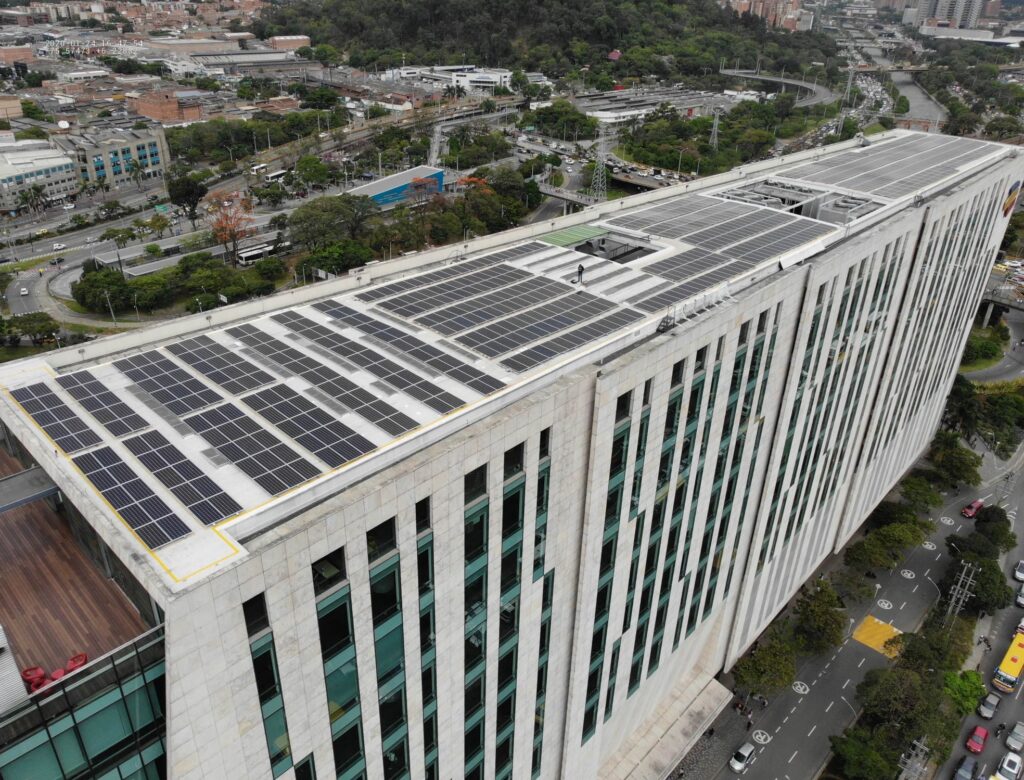
The implementation of geothermal, wind and biomass energy according to local conditions optimizes the use of available renewable resources.
Geothermal systems take advantage of the constant temperature of the subsoil for efficient heating and cooling, while urban wind energy and local biomass complement the renewable energy mix.
Energy storage and intelligent consumption management strategies maximize the efficiency of renewable systems. New generation batteries allow solar energy to be stored for night use, while intelligent management systems optimize consumption depending on the availability of renewable energy and electricity rates.
In addition, examples of buildings that generate more energy than they consume (Energy-Positive Buildings) demonstrate the technical and economic feasibility of this approach. These projects not only achieve operational carbon neutrality, but they also contribute positively to the decarbonization of the electricity grid.
Integration with intelligent power grids and Microgrids urban energy optimization allows energy optimization at the district scale. These systems facilitate energy exchange between buildings, maximizing the use of local renewable generation and improving urban energy resilience.
LEED v5 and its approach to decarbonization establish specific requirements for carbon reduction that go beyond traditional energy efficiency. This evolution of the LEED standard incorporates embedded carbon metrics and requires environmental product declarations, transforming certification towards a comprehensive approach to sustainability.
BREEAM and its criteria for evaluating emissions in materials and energy provide a European framework that is gaining global adoption. This system evaluates carbon impact throughout the life cycle, including specific criteria for selecting low-impact materials and operational decarbonization strategies.
The standard Passivhaus and its contribution to ultra-low energy buildings represents excellence in energy efficiency. Although originally focused on operational consumption, the new versions incorporate incorporated carbon considerations, setting the path to truly sustainable buildings.
The certification EDGE for emerging markets and their applicability in Latin America, it offers a practical approach adapted to regional conditions. This standard considers local economic and technical constraints, providing an accessible framework for implementing sustainable construction in developing countries.
The reduction of operating costs of 20-50% in long-term energy consumption represents one of the most tangible economic benefits of low-carbon construction. This reduction is achieved through integrated energy efficiency strategies, the use of renewable energy and intelligent management systems that optimize performance over the entire useful life of the building.
The increase in real estate value and attractiveness for investors ESG (Environmental, Social, Governance) is transforming the dynamics of the real estate market. Buildings certified as sustainable experience increases in value of 10-20% and higher occupancy rates, while institutional investors prioritize assets that meet ESG criteria.
Access to green finance and green bonds with preferential rates facilitates the economic viability of sustainable projects. Green bonds offer interest rates 0.5-1% lower than conventional funding, while government programs provide tax incentives and subsidies for low-carbon construction.
In addition, the improvement in occupant health and productivity generates significant indirect economic benefits. Sustainable buildings reduce work absenteeism by up to a 15% and they increase productivity by up to a 8%, creating economic value that far exceeds the additional costs of sustainable construction.
The Mexican regulatory framework, including the NOM-008-ENER and government energy efficiency programs, is laying the groundwork for the mass adoption of sustainable construction. These programs provide economic incentives for buildings that exceed minimum energy efficiency standards and reduce their carbon emissions.
Pioneering projects in Mexico such as Torre Reforma, Business Habitat Metro Center and developments of FAMED demonstrate the viability and benefits of low-carbon construction under local conditions. These projects have achieved emission reductions of 30-50% compared to conventional buildings, setting benchmarks for future developments.
Region-specific challenges include technology costs, limitations in technical training, and adaptation of local regulations. The limited availability of certified low-carbon materials and the need to develop local supply chains represent obstacles that require innovative solutions and public-private collaboration.
Market growth opportunities are based on growing demand and government support. The sustainable construction market in Mexico is growing at rates above 15% annual, driven by environmental regulations, corporate demand and climate change awareness.
Collaboration with international organizations and technology transfer accelerates regional implementation. For example, programs from the BID, the World Bank and development agencies provide funding and technical assistance for pioneering projects, facilitating the adoption of international best practices.
Detailed analysis of specific projects with proven emission reductions provides concrete evidence of the benefits of low-carbon construction. Torre Reforma in Mexico City it achieved a reduction of 40% in energy consumption through integrated passive design strategies, efficient systems and renewable energies.
The lessons learned emphasize the importance of comprehensive planning from early design stages, careful selection of local materials, and ongoing training of technical teams. The most successful projects integrate sustainability considerations from the initial conceptualization.
Testimonials from developers, architects and end users confirm the multiple benefits of low-carbon construction. Developers report greater ease of obtaining funding and permits, while users highlight better indoor air quality, superior thermal comfort and lower operating costs.
The comparison with international reference projects places Latin American developments in competitive positions. Projects such as Business Habitat Metro Center they achieve standards comparable to European and North American developments, demonstrating regional technical capabilities.
Low-carbon construction has established itself as the new sustainable standard essential to face the global climate crisis. Throughout this blog, we have seen how the construction industry, responsible for a large part of greenhouse gas emissions, is being transformed to minimize its carbon footprint through comprehensive strategies that range from the design and selection of materials to the operation and demolition of buildings.
The incorporation of low-carbon materials, renewable technologies such as solar and geothermal energy, and digital tools such as BIM, make it possible to optimize energy consumption and significantly reduce environmental impact throughout the life cycle of buildings. In addition, international standards and certifications, such as LEED, promote the adoption of practices that not only improve energy efficiency, but also promote quality of life, equity and environmental conservation.
In Mexico and Latin America, low-carbon construction represents a real opportunity to move towards sustainable development, with tangible economic, social and environmental benefits. Adopting this model is not only a necessary effort to meet international commitments and emerging regulations, but it also positions projects as leaders in innovation, health and well-being, ensuring a resilient and prosperous future for generations to come.
Leaf Global. Copyright © 2026. All rights reserved.