He leads projects and consulting services under LEED, EDGE, and FITWEL standards, integrating facade optimization strategies, life cycle assessments, and energy modeling to develop high-performance buildings.
By manufacturing modules in factories and assembling them on site, these technologies offer speed, precision and efficiency. This blog examines the advanced tools that are driving this transformation, from precision machinery to design software.

Image taken from inarquia.es
Modular construction is a building method in which modules are manufactured in a controlled environment, such as an industrial plant, and then transported to the site where they are assembled. This approach makes it possible to optimize times, reduce costs and maintain greater quality control compared to traditional construction. In addition, since it can be carried out in parallel with the works on site, it significantly speeds up project deadlines and reduces impacts on the environment.

Image taken from blog.zeroconsulting
Modular construction has its roots in the 19th century, when prefabrication techniques began to be developed to streamline construction processes. During the 1900s, the construction industry experienced a series of transformations with the introduction of new methods that allowed a significant evolution in the way of building. However, despite its long history, modular construction did not innovate for decades, until new perspectives and approaches began to transform the sector.
Industrialization has played a crucial role in the modernization of modular construction. The production of components in factories under controlled conditions, known as offsite solutions, has improved the efficiency and quality of the construction process.
In addition, modern construction methods, such as the use of specific volumetric systems, have allowed significant advances in the speed and efficiency of projects. These innovations have led to a reduction in delivery times and minimization of waste, offering superior quality control compared to traditional industries.
In a world in constant socio-economic change, modular construction is presented as an agile response to the emerging needs of society. The ability to adapt quickly to new demands and conditions has made modular construction an increasingly attractive option for architects, engineers and builders looking for efficient and sustainable solutions.

Image taken from kuka.com
Modular construction wouldn't be possible without advanced technologies that optimize every step of the process. From precision machinery to innovative software, these technologies enable efficient and high-quality module manufacturing.
In this section, we'll talk about three key areas: advanced machinery, design software and assembly techniques.
Advanced machinery is essential for accurate and efficient module manufacturing. Some examples of this machinery are:
These robots improve the speed and consistency in the joining of components, and ensure higher quality in the final product.
Laser cutters, on the other hand, allow precise cuts in various materials, minimizing waste and optimizing the use of raw materials.
In addition, robotic arms play an important role in the manufacture of modules, being used in almost all prefabricated construction projects. These arms allow for precise and safe handling of materials, contributing to a more efficient and high-quality production, reducing the need for labor.
Design software is another fundamental part of modular construction. Tools such as the CAD allow unprecedented precision and customization, facilitating the creation of three-dimensional models that help to visualize the project before construction. Not only do these tools improve design accuracy, but they also allow for quick and efficient adaptations according to project needs.
3D printing is also being used in modular construction to create elements adapted to the exact specifications of the project. Not only does this facilitate unique designs, but it also optimizes component manufacturing, ensuring that each piece fits perfectly into place.
Assembly techniques ensure that the modules are assembled efficiently and safely. 3D printing is used to assemble custom components, revolutionizing the way modular structures are manufactured and assembled. This technology makes it possible to create precise components that fit perfectly on the construction site, improving the efficiency and quality of the process.
A notable example is the on-site assembly approach of Wallex, which focuses on efficiency to accelerate the assembly process. This method allows for faster construction with fewer errors, ensuring a more efficient and high-quality delivery.

Image taken from Alquimodul-Peru
The materials used in modular construction have evolved significantly, with an increasing focus on sustainability and energy efficiency. Innovations in materials are helping to reduce environmental impact and improve the quality of modular buildings, including the use of renewable energy.
In this section, we'll talk about composite materials, advanced thermal insulation, and recycled materials, including OSB and expanded polystyrene (EPS).
The use of composite materials in modular construction can significantly increase the strength and durability of modules. These materials, which combine several raw materials, offer superior characteristics compared to traditional materials, allowing the creation of more robust and durable structures.
Among the raw materials used in these compounds, fiberglass, carbon fiber and epoxy resins stand out, which are essential to guarantee their quality and structural performance.
Modern insulation technologies are designed to maximize energy efficiency in modular buildings. A prominent example is the use of panels SIP (Structural Insulated Panels), which combine a thermal insulation layer with a support structure, providing a comprehensive solution to reduce energy consumption.
Advanced thermal insulation systems contribute to the reduction of energy consumption, which benefits the environment and reduces long-term operating costs. These systems make it possible to maintain comfortable indoor temperatures regardless of external weather conditions, thus improving overall energy efficiency.
The use of recycled materials in modular construction contributes to the reduction of waste and promotes sustainable practices. Incorporating these materials reduces the need to use virgin resources and promotes greener construction.
Prominent examples include the use of OSB (Oriented Strand Board) and expanded polystyrene (EPS), which are widely used recyclable materials due to their versatility and insulating properties.
OSB is a material composed of recycled wood chips, known for its strength and durability, ideal for modular structures. On the other hand, EPS offers excellent thermal insulation properties, contributing to the energy efficiency of buildings.
The use of these recyclable materials favors the reduction of waste and promotes sustainable practices in modular building, encouraging a more responsible construction industry aligned with the principles of sustainability.

Automation and digitalization in the modular construction industry. Image taken from new.abb
Automation and digitalization are transforming the modular construction industry, allowing for more efficient and accurate production. The integration of standardized industrial processes optimizes component production and reduces waste.
In this section, we'll discuss how the BIM, the IoT and additive manufacturing are revolutionizing this sector.
BIM is a methodological approach that allows the creation and management of digital information for construction projects. This approach facilitates collaboration between different disciplines, promoting efficiency in the design and development of modular projects.
The use of BIM tools makes it possible to carry out simulations and visualize the project before its construction, ensuring a more effective design and reducing errors. In addition, it contributes to project management through the possibility of monitoring progress, managing changes and coordinating between different work teams effectively.
The IoT allows real-time monitoring of processes during the construction and use of modular buildings. The integration of IoT into modular construction allows continuous monitoring and management of building processes, improving operational efficiency.
In addition, it allows buildings to be converted into intelligent structures using sensors that monitor conditions and resources in real time. This optimizes the operation and maintenance of modular buildings, improving efficiency and reducing costs.
3D printing is an innovative technique in modular construction that allows the precise and efficient manufacture of components. This technology makes it easy to create customized modular components that adapt to specific design requirements, offering great versatility.
The use of 3D printing in modular construction improves efficiency and contributes to more sustainable practices by optimizing the use of resources. The ability to build complex shapes that would be difficult to achieve with traditional methods is another significant advantage of this technology.

Wooden Legos Modular system made of wooden blocks. Image taken from arcus-global
Modular construction has allowed the creation of innovative projects that stand out for their efficiency and design. From sustainable housing to commercial buildings and public infrastructure, these projects demonstrate the potential of modular construction to transform the industry.
In this section, we'll look at some notable examples, including prominent cases from Latin America.
Modular construction allows for faster construction by using prefabricated components that arrive ready for assembly at the construction site. A prominent example is the MINI Living Project in London, which uses modular construction to develop compact and adaptable housing, demonstrating an innovative approach to the use of urban space. This project shows how modularity can be an effective solution for housing in densely populated cities.
In Latin America, a notable example is the modular housing project in Chile, where prefabricated modules have been used to build sustainable and earthquake resistant houses. This approach speeds up the construction process and ensures high quality and structural safety.
Modular construction offers numerous advantages for commercial buildings, including reduced delivery times and flexibility in design. Modular retail spaces can be quickly assembled and adapted to changing market needs, which is crucial for maintaining competitiveness. This allows companies to open new facilities in less time and with fewer interruptions.
A notable example is the Brock Commons Building in Vancouver, an 18-story building built using modular techniques. This project demonstrates the efficiency and speed of modular construction, providing high-quality commercial space in record time.
In Mexico, a particular case is the development of temporary hospitals during the COVID-19 pandemic. These modular hospitals allowed a rapid response to the health emergency, offering adequate spaces for medical care in record time. The implementation of these modular structures demonstrated how modular construction can be an effective solution for emergency situations, ensuring quality and efficiency in the use of resources.
Relocatable buildings represent an ideal solution to cover temporary space needs in sectors such as transport, education or health. These structures are designed to be easily moved or relocated, offering exceptional flexibility.
Common applications include:
These structures can be quickly deployed and used in response to emergencies or temporary demands.
One of the great advantages of relocatable buildings is their quick delivery. They also have the ability to be reconfigured at a reduced cost. This allows public institutions to respond quickly to changing needs, ensuring that there is always sufficient and adequate space for their operations.
In Colombia and Peru, modular construction has been used to develop school classrooms in remote areas, allowing for quick installation and adaptability to local conditions. This approach has improved access to education, demonstrating the versatility of modular construction in public infrastructure.
The use of advanced technologies in modular construction presents a number of requirements and challenges. While these technologies can improve efficiency and reduce costs, they also face obstacles such as resistance to change and the need for specialized training.
In this section, we'll look at these aspects in detail.
Modular construction can reduce construction time by a 30% to 50% compared to traditional methods. This speed allows modular buildings to open to the public much faster, generating revenue before traditional construction methods. In addition, optimization in modular construction can achieve a drastic reduction in costs, which benefits both builders and customers.
Modular construction significantly improves work safety by keeping workers in a controlled and safe environment. Building off-site allows for better control of construction quality, eliminating high humidity levels and improving air quality in projects. In addition, condition control avoids depending on the weather for assembly, which improves the final quality of the product.
Finally, modular construction projects contribute to the reduction of environmental impact through a lower use of resources and shorter execution time. According to CEMEX, modular construction is faster, more efficient and uses resources better, resulting in fewer materials used.
One of the main challenges of modular construction is resistance to change due to the complexity and fragmentation of the sector. This resistance makes it difficult to adopt new technologies, creating an environment that discourages companies from integrating innovations into their processes.
In addition, the lack of specialized training is a major obstacle to their effective implementation. Overcoming these institutional and educational barriers is important to promote innovation in the sector and to make the most of the benefits of advanced technologies.
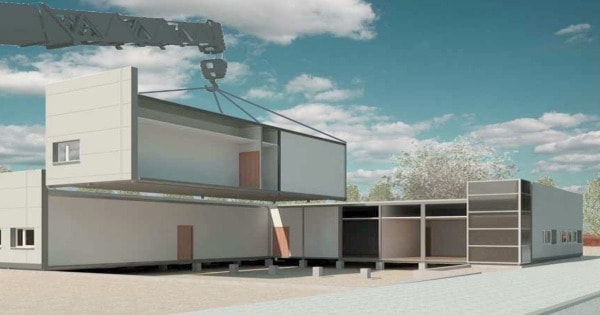
Image taken from Seisamed
Modular construction has gained a great deal of momentum in recent decades. This phenomenon is especially notable in the modern context. This trend is expected to continue, with an evolution towards the large scale module system that will include not only individual buildings, but also complex infrastructures such as hospitals and schools.
Its application is particularly relevant in emergency contexts, where it allows the rapid implementation of temporary housing solutions that guarantee minimum conditions of habitability and security.
Modular construction is considered an efficient solution for reconstruction after natural disasters, allowing for the rapid provision of temporary shelters that guarantee the safety of those affected, unlike traditional construction methods, also contributing to resource savings.
At the same time, the adoption of disruptive technologies is redefining construction processes: 3D printing enables the accelerated manufacture of modules with minimal waste generation, while artificial intelligence optimizes architectural and structural design through predictive analysis, promoting energy efficiency and functional customization. These innovations position modular construction as a strategic axis in the sustainable and resilient transformation of the built environment.
Modular construction is changing the way we build, offering a faster, more efficient and sustainable alternative to traditional methods. From advanced technologies in module manufacturing to material innovations and digitalization, every aspect of modular construction is designed to improve efficiency and reduce environmental impact. With examples of innovative projects and a focus on sustainability, the future of modular construction is promising.
Modular construction is a building approach in which modules are produced in a controlled environment and installed at the destination, allowing for greater efficiency and quality control in the construction process. This method facilitates faster and more cost-effective construction.
Modular construction offers multiple advantages, such as reduced construction time and costs, as well as improved energy efficiency and sustainability. These characteristics make it an attractive and modern option in the field of construction.
Modular construction uses technologies such as advanced machinery, CAD design software, BIM, IoT and additive manufacturing. These tools optimize efficiency and precision in the construction process.
Modular construction uses composite materials, advanced thermal insulation systems and recycled materials, which contribute to the sustainability and energy efficiency of the projects. This diversity of innovative materials optimizes the construction process and minimizes environmental impact.
Some examples are the MINI Living Project in London, the Brock Commons Building in Vancouver and the implementation of relocatable buildings in public infrastructure. In Latin America, a prominent example is the modular housing project in Chile, where prefabricated modules have been used to build sustainable and earthquake resistant houses. These cases reflect the versatility and efficiency of the modular approach in contemporary construction.
Leaf Global. Copyright © 2026. All rights reserved.