He leads projects and consulting services under LEED, EDGE, and FITWEL standards, integrating facade optimization strategies, life cycle assessments, and energy modeling to develop high-performance buildings.

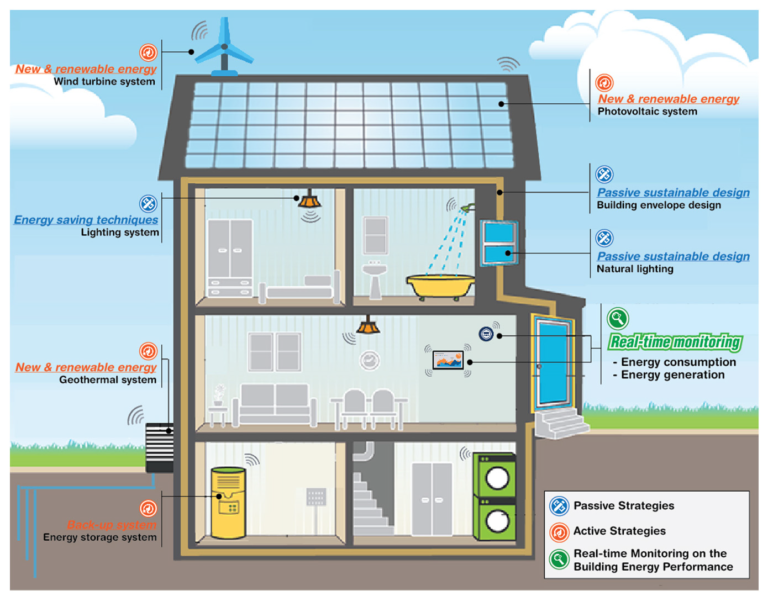
Excerpted from Advanced Strategies for Net-Zero Energy Building: Focused on the Early Phase and Usage Phase of a Building's Life Cycle
A Net Zero buildings are those highly efficient that balance their energy consumption with the production of renewable energy generated on site, close to the site or purchased from renewable sources.
In other words, these buildings are designed to minimize energy consumption and offset any remaining demand with carbon-free energy. The Net Zero concept involves not only reducing energy consumption as much as possible, but also ensuring that all the energy used comes from renewable sources.
There are several categories of Net Zero, including:
All future buildings should aim to be Net Zero to contribute significantly to the reduction of carbon emissions globally.
There are several terms that describe CO₂ emissions from buildings and construction. In the Roadmap for Energy Efficient Buildings and Construction in the Association of Southeast Asian Nations (IEA 2022e), recently published, presents these different terms, which may apply to different scopes and limits of the site.
Progress toward net zero carbon buildings can include:
Source: Global Status Report for Buildings and Construction, United Nations Environment Programme

Zero carbon building levels. Global Status Report for Buildings and Construction

Excerpted from energytracker.asia
Achieving Net Zero buildings requires combined strategies for energy efficiency, use of renewable energy, and building lifecycle management:

Extracted from efficiencycanada.org

The Edge. Taken from blog.bulldozair.com
These buildings contribute significantly to the carbon neutrality objectives set by various global policies. In the European Union, the Directive 2012/27/EU establishes energy efficiency standards that must be implemented by member States. In addition, the Net Zero Emissions Industry Act seeks to facilitate the production of clean technologies in the European Union, promoting a favorable environment for sustainable buildings.
In Spain, the Architectural Quality Act contributes to the construction of Net Zero buildings. These policies and regulations not only support sustainable construction, but they also encourage innovation in clean technologies and energy efficiency practices.
Regulations for decarbonization focus on net zero carbon emissions by 2050.
The building must demonstrate zero net energy consumption for at least 12 months.
Energy must come exclusively from on-site renewable sources.
The use of fossil fuels is not allowed.
It complements the LEED certification with the recognition of zero net energy balance.
It requires a measurement period of 12 months verifying that the total energy consumption is equal to or less than the generation of renewable energy.
Passivhaus Plus: It generates as much renewable energy as it consumes annually.
Passivhaus Premium: It generates more renewable energy than it consumes.
It focuses on reducing and offsetting carbon emissions associated with a building's energy consumption.
It requires annual measurement and verification.
It establishes requirements for renewable energy and the reduction of carbon emissions in buildings.
It considers operational and construction material emissions.
It recognizes buildings that fully offset their carbon emissions through efficiency and renewable energy strategies.
It certifies buildings that comply with the EDGE certification and achieve a net zero emission balance over their useful life.

Futuristic vision of Net Zero buildings
In the future, solar and wind energy will be essential, representing almost 70% of global electricity generation by 2050. Cities that adopt Net Zero buildings will be able to benefit from long-term savings in energy and maintenance costs.
The future of Net Zero buildings is promising, with continued advances in renewable energy and energy efficiency technologies. As more cities and countries adopt these standards, we can expect a significant reduction in carbon emissions and an improvement in the quality of urban life. The transition to Net Zero buildings is, therefore, a crucial investment for a sustainable future.
Net Zero buildings represent the future of sustainable construction, offering environmental, economic and comfort benefits. Through innovative design strategies, renewable energy and resource efficiency, these buildings mark the path to more resilient and sustainable cities.
Leaf Global. Copyright © 2026. All rights reserved.