He leads projects and consulting services under LEED, EDGE, and FITWEL standards, integrating facade optimization strategies, life cycle assessments, and energy modeling to develop high-performance buildings.
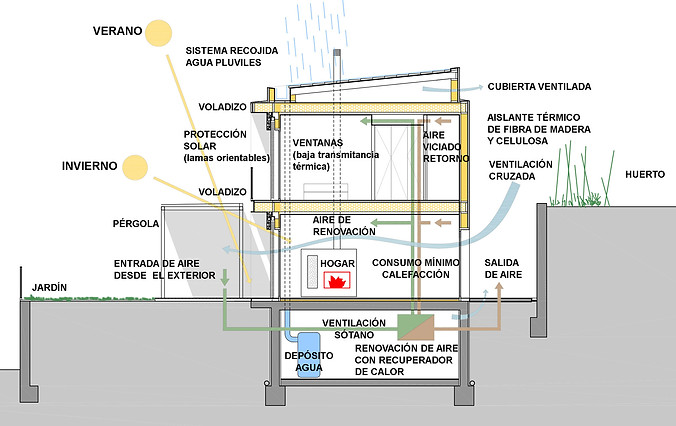
It is common to have thermal energy needs for both heating and cooling in buildings. During winter, the main strategy is to capture, store and conserve as much energy as possible. On the other hand, in summer, the priority is to avoid overheating the building. This is achieved by reducing solar radiation in the façade glass, ventilating and cooling the building when the outside temperature decreases, and minimizing internal loads, especially in commercial buildings.
To control solar radiation in summer, the sun protections in glazed openings are highly effective. These protections, whether fixed or mobile, are essential to reduce cooling demands. Fixed horizontal elements such as overhangs, horizontal slats and pergolas are effective in the south orientation, but in the east and west orientations, mobile protections or vertical slats are more effective due to the low solar height. Integrating solar energy collection systems into these protections is also an interesting option.
As for the ventilation and cooling, taking advantage of ventilation is a key strategy for reducing cooling loads. The entry of air cooler than the comfort temperature dissipates the heat accumulated in the building's thermal mass, alleviating the interior temperature and improving the feeling of comfort. La cross ventilation, which involves air inlet and outlet on different facades, is especially effective. However, its design is more complex in commercial buildings, where many variables must be considered, and simulation with airflow software is often required.
La mechanical ventilation, driven by devices such as fans, is another strategy. Its use does not compete with natural or air conditioning systems, but can be integrated to maximize overall efficiency. There are systems that take in outdoor air to heat it up and maintain indoor air quality, and others that manipulate the velocity of indoor air to create currents and improve wind chill.
In addition, free cooling is a practice promoted by regulations such as the RITE. This system is based on introducing outdoor air when its enthalpy is lower than that of indoor air, allowing renewal without the use of compressors. You can also take advantage of the night ventilation, using natural or mechanical air currents during the night to cool the building taking advantage of lower temperatures.
In short, implementing adequate sun protection, ventilation and cooling strategies is essential to achieve energy efficient and sustainable buildings, both in terms of comfort and energy consumption.
Leaf Global. Copyright © 2026. All rights reserved.