He leads projects and consulting services under LEED, EDGE, and FITWEL standards, integrating facade optimization strategies, life cycle assessments, and energy modeling to develop high-performance buildings.

A resilient building is one that can face and recover after a disaster situation, while maintaining safety and functionality for its occupants. These buildings are designed to withstand extreme natural phenomena and other adversities, and are equipped with efficient systems that ensure their operability and adaptability in emergency situations.
The strategies to consider will depend on the level of threat being faced. One way is to prioritize these four elements:
The building must be able to continue operating in crisis situations.
It depends to a large extent on the building's design, which should minimize dependence on external resources and allow flexibility at critical times.
It's a crucial aspect in designing building systems that can withstand damage and continue to operate after the immediate threat has passed. It includes well-developed contingency plans, effective emergency operations, and the means to mobilize people and resources to the right places.
It consists of duplicating the components of the construction system to support the original ones in case of failures. They can include backup generators, primary heating and cooling equipment, alternative water sources, and utility systems.
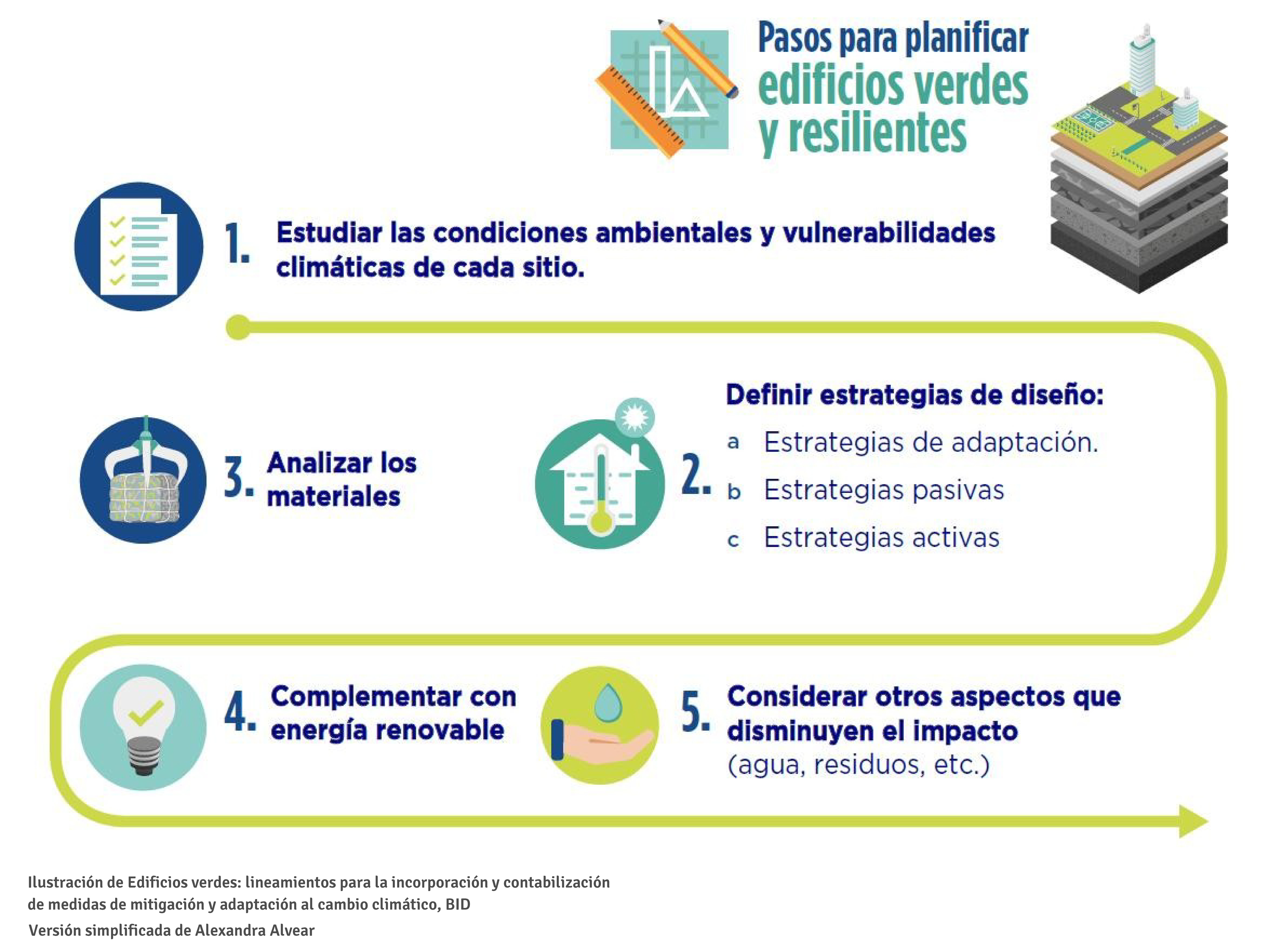
In addition, these five steps will guide you in planning green and resilient buildings:
In a context of drought and water scarcity, the following treatment and reduced use strategies can be incorporated:
In situations of rising sea levels, hurricanes, floods, torrential rains and storms, the following mitigation strategies can be implemented:
Faced with a scenario that anticipates an increase in temperature due to climate change, these strategies can be considered in buildings:
It is also recommended to adopt a multi-threat approach during project planning, ensuring that measures are implemented to improve resilience to various threats in addition to climate change, such as earthquakes.

Sources consulted:Origo Sustainable Architecture.Green buildings: guidelines for the incorporation and accounting of mitigation and adaptation measures to climate change, IDB.5 steps to planning green and resilient buildings, Alexandra Alvear.
Do you want to certify your project? contact us
Leaf Global. Copyright © 2026. All rights reserved.