He leads projects and consulting services under LEED, EDGE, and FITWEL standards, integrating facade optimization strategies, life cycle assessments, and energy modeling to develop high-performance buildings.

It is an environmental indicator that tangibilizes the greenhouse gas (GHG) emissions generated by an individual, company or activity. Its calculation is through an inventory of GHG emissions. In other words, it is only obtained with the data of activities to be analyzed, such a calculation system is based on different recognized international standards, such as ISO 14064, PAS 2050 or the GHG Protocol.
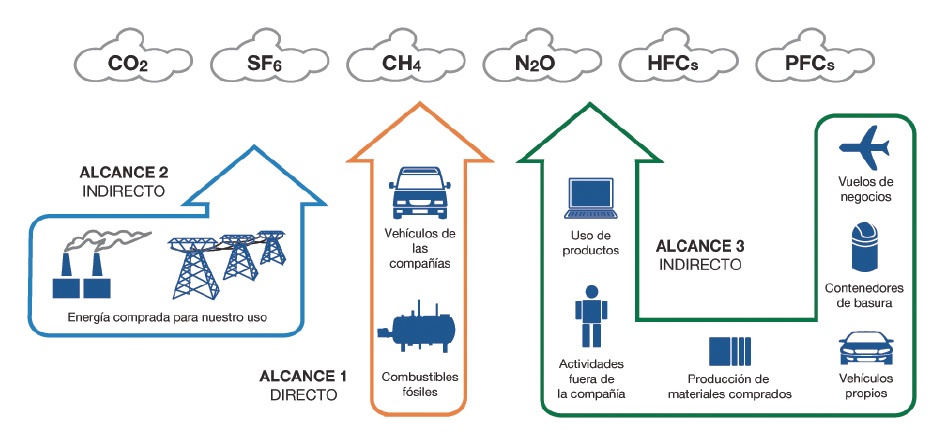
The activities to be analyzed are all those carried out by a person or company in a certain period of time [See the image below]. In addition, a person's carbon footprint will be the sum of the carbon footprint of all the activities that person performs over a period of time.
The carbon footprint is measured in a very particular unit: equivalent grams of carbon dioxide (GCO2eq). This unit makes it possible to quantify the environmental impact of all greenhouse gases in a single indicator.
To calculate the carbon footprint of a company, activity or individual, it is necessary to apply the following formula:
GCO2eq = Fe * A
Being:
It should be noted that the emission factor indicates how many grams of equivalent CO2 are generated in a given activity.
In order to find the corporate carbon footprint, it is necessary to know the 3 scopes of the study, which will allow us to classify activities. Depending on the purpose of the calculation, it may cover more or fewer company activities that generate CO2 emissions.
Scope 3 — Indirect emissions: Generated indirectly by the company along the value chain of the products it offers. For example: suppliers of parts, services or employee trips abroad contribute to emissions of this scope.
Amazon, the American e-commerce and IT services giant, has established an investment fund worth 2 billion dollars to support technologies that reduce CO2 emissions. This fund adds to their previous commitment to achieve carbon neutrality by 2040. Its objective is to promote the development of climate solutions by financing companies that offer products and services that contribute to reducing greenhouse gas emissions. With the so-called “Climate Pledge Fund”, Amazon hopes not only to benefit, but also to help other companies achieve carbon neutrality within the same time frame.
The Coca-Cola Company, for its part, has been dedicated to sustainable agriculture and has plans to sustainably obtain all the ingredients it uses in its products. With this strategy, it aims to reduce its carbon footprint by 25% by 2025.
Levi's, the American fashion company, has launched a fight against waste in the textile industry through a line of jeans made from recycled water bottles. In addition, it has partnered with other organic clothing brands. Levi's goal is to reduce emissions in its supply chain by 40% by 2025. To achieve this, they plan a series of actions, including a 90% reduction in greenhouse gas emissions in all their facilities, through investments in energy efficiency improvements and the use of renewable energy.
Finally, Nike, the American multinational sporting goods company, has strengthened its relationship with suppliers committed to ecological practices and has developed a line of sustainable products made with recycled materials. With these measures, Nike seeks to reduce its own carbon footprint and promote a more sustainable approach to the sports and fashion industry.
Leaf Global. Copyright © 2026. All rights reserved.