He leads projects and consulting services under LEED, EDGE, and FITWEL standards, integrating facade optimization strategies, life cycle assessments, and energy modeling to develop high-performance buildings.
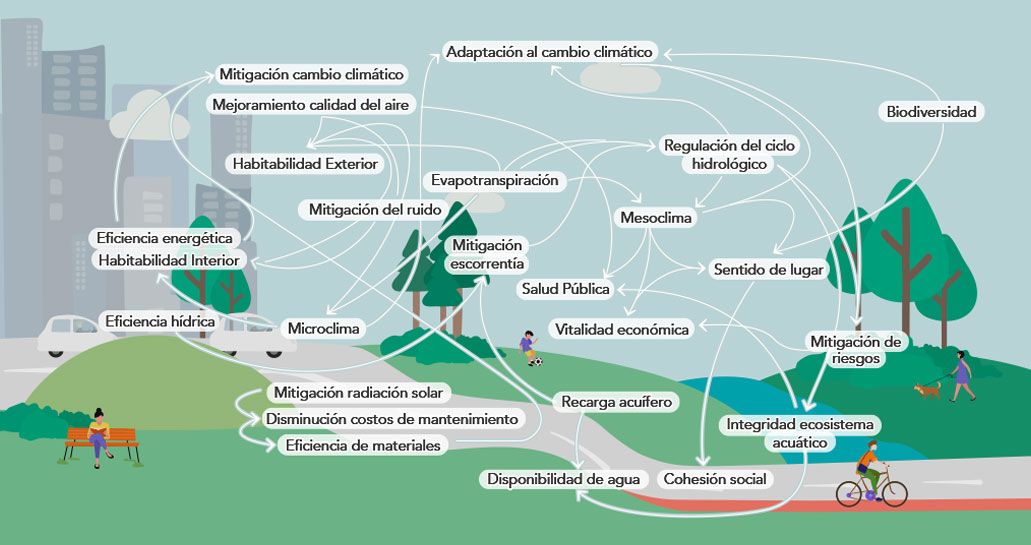
A sustainable city seeks to address and solve the problems generated by our cities through approaches and practices that promote quality of life, environmental protection and economic efficiency. They exist 3 key points that must be evaluated before building a sustainable city: Controlling urban sprawl, Rehabilitate the consolidated city, and to design new housing developments and buildings with bioclimatic criteria.
A sustainable city is one that shows resistance to the negative effects of climate change, by identifying and reducing the vulnerabilities of its population, strengthening its capacity to adapt and effectively managing disaster risks.
Urban planning plays a crucial role in creating sustainable and livable cities. Here are the main principles that guide this planning:
A key aspect of sustainable urban planning is the careful study of urban density. This involves finding a balance between the intensity of development and the capacity of existing infrastructure. Adequate density can promote land use efficiency and promote sustainable mobility.
A sustainable city must promote diversity in building morphology and typology. This involves the combination of different forms of buildings and urban structures, which allow housing, shops, offices and public spaces to coexist. Building diversity contributes to the vitality and quality of the urban environment.
Sustainable urban planning promotes the integration of mixed and compatible uses in the same space. This involves the harmonious combination of residential, commercial, industrial and recreational activities in a given area. Mixed uses reduce dependence on cars, promote community life and reduce unnecessary travel.
The presence of green areas and free spaces is essential in a sustainable city. These areas provide opportunities for recreation, contact with nature and improved air quality. In addition, structuring free spaces, such as green corridors or linear parks, can connect different parts of the city and promote sustainable mobility.
Sustainable urban planning must optimize existing maintenance networks and infrastructures. This means efficient management of water, energy, transport and waste. Optimizing infrastructure reduces environmental impacts and improves the quality of life of city residents.
The strategic location of integrated facilities is a key principle in sustainable urban planning. This implies the proximity of essential services, such as educational centers, health centers, recreational areas and cultural spaces, to ensure accessibility and improve the quality of life of residents.
Urban traffic management is essential for a sustainable city. Measures must be implemented to promote the use of public transport, promote active mobility (walking and cycling) and reduce dependence on cars. Efficient traffic management contributes to the reduction of pollution, congestion and traffic accidents.
Proper waste management involves the implementation of policies and practices that promote the reduction, reuse and recycling of waste generated in the city. In addition, it seeks to minimize waste production and promote the adoption of efficient waste treatment and disposal technologies and systems.
The environmental assessment of periurban space is an approach that involves the protection and conservation of the natural and agricultural spaces that surround urban areas. The integration of these spaces into urban planning guarantees ecological connectivity, the conservation of biodiversity and the provision of ecosystem services.
Social cohesion is a central aspect of sustainable urban planning. It involves the creation of inclusive communities, where diversity is promoted, equal opportunities are guaranteed and citizen participation in decision-making is encouraged. Social cohesion strengthens the community fabric and contributes to a better quality of life for all residents.
Sustainable urban planning offers numerous reasons for its effective implementation. Establish a framework for development and growth is one of them, since it provides a clear and coherent guide for the expansion of cities. In addition, if there is planning, we are better prepared to face future challenges, both environmental and socio-economic. The planning reduces the negative impact in the environment by carefully considering the location and design of urban projects. The right urban model is essential to create healthy and livable environments. In addition, good urban planning favors a good economy, since it promotes investment and sustainable development. By broadening the territorial perspective, it is possible to achieve an economy of scale by broadening the territorial perspective and maximize available resources. Credibility is based on continuity of long-term actions and policies. Anticipating is more effective than reacting to unexpected crises. Effective and coherent action and communication are key to ensuring the successful implementation of sustainable urban planning and achieving positive results for present and future generations.
Leaf Global. Copyright © 2026. All rights reserved.