The circular built environment

Home

>

Blog

>

The circular built environment

Globally, our linear systems of extracting, manufacturing and discarding have us heading towards an environmental, social and economic crisis, due to the use of materials and products that are dangerously unsustainable.

In addition to using renewable energy and energy efficiency measures in the built environment, the choice of sustainable building materials is also crucial to achieving climate objectives.

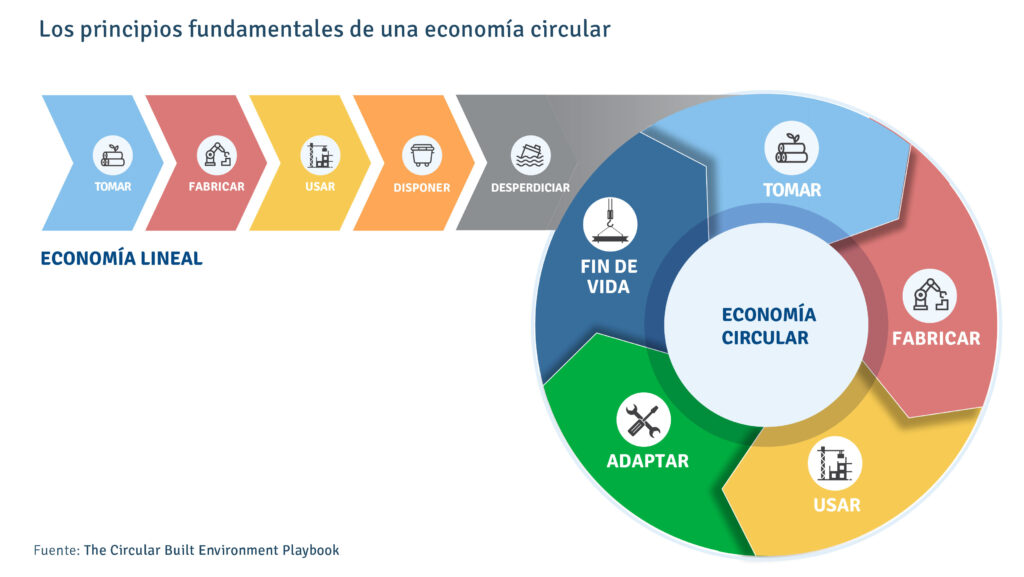
Fundamental principles of a circular economy

The essential principles of a circular economy for the built environment include:

  • Decrease in the use of materials and resources.
  • Maximizing the durability and use of materials and products.
  • Design focused on disassembly, reuse and recycling, with the goal of eliminating all waste.
  • Promotion of natural regeneration.

A circular building optimizes the use of resources while minimizing waste throughout its life cycle. Its design, operation and dismantling increase in value over time by:
  • Durable products and services made from secondary, non-toxic, sustainable, renewable and reusable materials.
  • Optimization of space over time through shared use, flexibility and adaptability.
  • Long-term durability, resilience, ease of maintenance and repairability.
  • Disassembly and reuse or recycling of materials, components and integrated systems.
  • Life Cycle Analysis (LCA), Life Cycle Cost Assessment (LCC), and easy access to digital information (such as building material passports).

Unlike linear economic models, in which resources are discarded at the end of their first functional use, a circular economy maximizes resource utilization and minimizes waste throughout their entire life cycle.

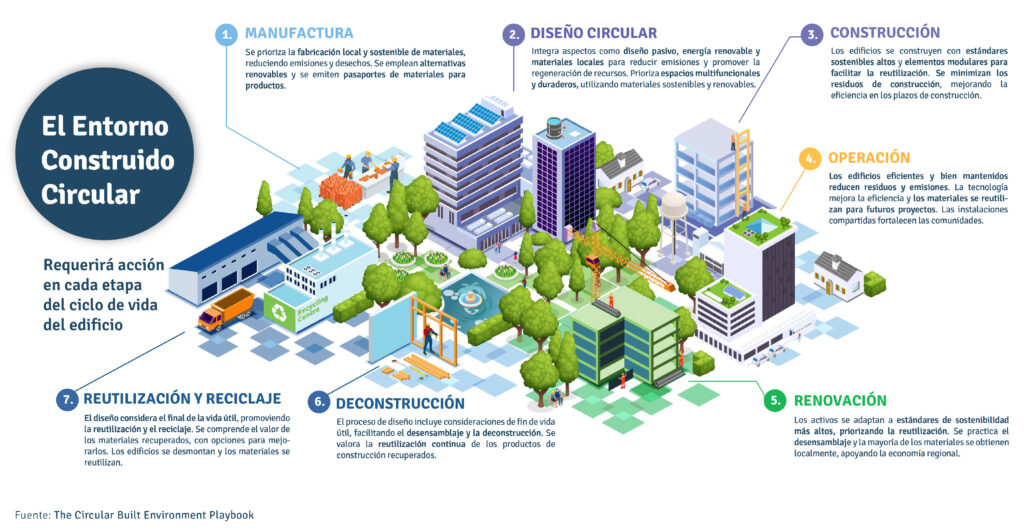
Stages of the circular built environment

During the phase of manufacturing, local, alternative and reused materials must be used, especially those recovered from the demolition of buildings. It is a priority to use renewable energy sources and to manage natural resources efficiently.

In the phase of layout, it is crucial to prioritize energy efficiency through passive design strategies, as well as to promote the generation and use of renewable energy. In addition, it is essential to prefer local, reused or alternative materials. The design must incorporate facilities for maintenance, disassembly and dismantling.

During the phase of construction, construction methods with low incorporated carbon are applied, such as modular construction, and high performance standards are established for waste management. It is also a priority to use sustainable materials and products throughout the process.

In the phase Operational or use, buildings must be properly maintained, which extends the useful life of assets and their components. Waste generation is minimized and natural capital is restored and protected.

In the stage of upgrading or adaptation, all assets must be upgraded to higher sustainability standards. Priority is given to reuse rather than demolition.

When you arrive at the end of its useful life, it is essential to focus on carrying out a complete disassembly and deconstruction, thus allowing all construction materials, products and components of the building to be reused. In this way, it seeks to avoid demolition and the shipment of building components to landfills.
Key roles of actors

Moving to a circular economy in the built environment will only be possible through urgent and coordinated action by all sectors of society. Especially, through public sector regulatory enforcement and private sector leadership.

  • Developers and investors: integrate the circular economy into their ESG and sustainability strategy, using lifecycle assessments and digital modeling, and allowing alternative materials.
  • Manufacturers and suppliers: Use alternative and reused materials, explore product returns, and collect and disclose data to increase transparency in the supply chain.
  • Designers: Prioritize circularity, using materials with passports and EPDs, and promote alternative and reused materials.
  • Contractors: build adaptable assets, maintain sustainable procurement practices with local materials and low environmental impact, and minimize construction waste.
  • Asset owners/occupants, users and managers: use shared business models, adapt assets for different uses, protect natural resources on the site and minimize the generation of operational waste to landfills.
  • Deconstruction: At the end of the building's useful life, recover all materials to reuse, repair or recycle them to extend their usefulness, avoiding demolition waste.
  • Policymakers: facilitate the implementation of circular design principles through appropriate regulatory changes that promote the use of circular services and products.

Source: The Circular Built Environment Playbook by WorldGBC

Si quieres recibir este ebook,
¡suscríbete!

Portada de ebook azul con texto sobre oportunidades de financiamiento para construcción sostenible en América Latina y logo de Leaf.

Para Leaf, tu privacidad es fundamental. Por eso, utilizamos los datos que nos proporcionas para acercarte novedades e información relevante. Al descargar, muestras tu conformidad con ello. Puedes cancelar tu suscripción en cualquier momento.

Thank you! Your submission has been received!
Oops! Something went wrong while submitting the form.
EDGE Certification: The Fastest Way to Build an Efficient Building

EDGE certification is one of the fastest and most effective ways to create efficient buildings, reduce energy, water, and material consumption, and increase property resale value. Developed by the International Finance Corporation (IFC), part of the World Bank Group, EDGE helps real estate projects lower their environmental impact, reduce operating costs, and support decarbonization efforts. With a streamlined and measurable process, EDGE has become a strategic certification for developers and investors seeking sustainability, profitability, and market differentiation.

Sustainable certifications in Mexico: current overview and trends

Sustainable certifications in Mexico are gaining prominence as a key tool for companies and projects that seek to demonstrate their environmental, social and governance commitment. They are no longer limited to construction alone, but encompass complete processes, operations, products and business models.

Why environmental certifications increase the resale value of a property | Leaf

Discover how environmental certifications, energy efficiency and sustainable buildings increase the resale value of a property and reduce its environmental impact.

Logo with the word 'leaf' in white and text 'Sostenibilidad para todos' in blue next to two green leaves.

PERÚ

PANAMÁ

COLOMBIA

CHILE

CHINA

MÉXICO

CDMX

Monterey

SÍGUENOS EN

Instagram logo
Logo facebookLogotipo de LinkedIn en blanco sobre fondo azul.