He leads projects and consulting services under LEED, EDGE, and FITWEL standards, integrating facade optimization strategies, life cycle assessments, and energy modeling to develop high-performance buildings.

Sustainable architecture is an emerging topic in Latin America and more and more countries in the region are betting on it, as a result of the consequences of globalization. In addition, various government institutions are devising strategies to promote sustainable urban design, the construction of green houses and the creation of safe and environmentally friendly spaces.
Sustainable architecture consists of designing and constructing buildings that are more efficient in the use of natural resources, such as water, energy and materials, and that have a minimum impact on the environment. This involves using innovative technologies and materials that are more environmentally friendly, as well as implementing design practices that maximize natural lighting, ventilation and the use of renewable energy.
In this article we will focus on Mexico and talk about 7 of its sustainable architecture projects.
> You may be interested in: How to have a sustainability certification?
Known as the most innovative skyscraper in the world, it has LEED Platinum certification for its intelligent design, which allows it to save 25% more energy than other buildings around it, and because 85% of the materials were of Mexican origin for its construction, which prevented a carbon footprint from being formed by transport. This building is an example of how sustainable architecture is advancing in our country.
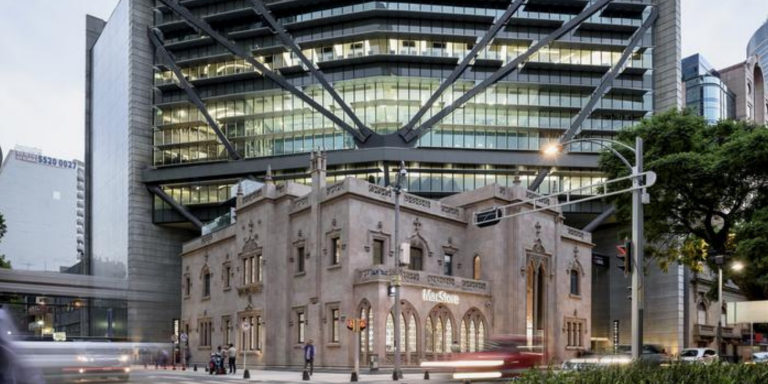
He was the first in Mexico to obtain double certification in Environmental Energy Leadership (LEED) in the Commercial Buildings category. It has 105,000 LED bulbs and a water treatment system to reduce the cost of vital liquid by 20 percent.

It is designed to take advantage of natural lighting and ventilation in the area. It functions as a public library and a botanical garden that is like a vent for the city center. It has more than 26 square hectares with more than 60,000 specimens of 168 species of trees, shrubs and plants. This project is an example of how sustainable architecture can benefit our country.

This hotel is built with recycled concrete tubes arranged in the shape of a pyramid and incorporates water-saving systems. Each tube houses a thermal and minimalist room, closed with glass that offers a beautiful view of the Tepozteco Mountains. This hotel is an example of innovation in sustainable architecture in our country.

Achieved with recycled maritime containers, a space was born that has restaurants, galleries, bars and shops.

It has two 20-story buildings connected by habitable bridges and an interior garden. It has ventilation scales to keep it cool and the lighting is improved thanks to the screen-printed and sandblasted glass.

This office building is located in Mexico City. It has a space of 5,000 square meters open to its employees, who use it to work, exercise or take yoga classes. It opened nine years ago and has an orchard where various types of herbs and vegetables are cultivated and consumed by its workers. In addition, it has solar panels that heat the water in the showers.

In conclusion, in Mexico, there is a growing number of sustainable architecture projects that use innovative technologies and materials to promote sustainability and reduce the environmental impact of buildings.
Do you want to design and develop your next sustainable building in Mexico? Contact us to accompany you in the process.
Leaf Global. Copyright © 2026. All rights reserved.