He leads projects and consulting services under LEED, EDGE, and FITWEL standards, integrating facade optimization strategies, life cycle assessments, and energy modeling to develop high-performance buildings.
Thanks to the signing of an agreement with the Foundation for Accessibility and Social Responsibility (ARS Foundation), Leaf is now an Authorized Entity to apply the Accessibility Indicator (AIS) system.
This is the certification of the degree of accessibility of a building with greater international reach. Present in more than 30 countries, the AIS system has issued more than 3,381 certificates since 2013 and has more than 40 advisors worldwide.
The ARS Foundation is a private, non-profit organization with a national and international reach. She is the creator and owner of the AIS 1/2018 and AIS 1/2023 Standards. Its objective is to improve society by promoting the integration of all people, regardless of their status.

AIS makes it easy to value and recognize excellence in accessibility. Explaining what accessibility consists of requires introducing the concept of Diversity and Inclusion, these being the end in itself of accessibility. In addition, accessibility must be comprehensively understood in its three dimensions: physical, sensory and cognitive.
The AIS system has a significant reach, present in more than 30 countries and backed by an organization dedicated to improving social integration. AIS is the most recognized and prestigious international accessibility certificate in the world.
Physical or virtual spaces and products are considered accessible, whose characteristics allow them to be enjoyed safely, comfortably, with maximum usability and in the most autonomous way possible, by priority groups (older adults, pregnant women, people with functional diversity, etc.) and by all people in general.
In this way, AIS standards contribute to achieving the United Nations Sustainable Development Goals and are integrated with ESG strategies.
AIS is an international standard that assesses the degree of accessibility of services, facilities and products. Its main objective is to ensure that all people, regardless of their needs, can interact comfortably and safely with the services and products offered.
AIS addresses accessibility in three fundamental dimensions: physical, cognitive and sensory. This comprehensive approach is essential for any company that wants to ensure that it is properly meeting accessibility and usability criteria.
By implementing AIS standards, companies not only improve their customer experience, but they also demonstrate their commitment to inclusion and social responsibility.
Obtaining AIS certification offers a number of significant benefits for businesses and organizations. First, it improves the accessibility and usability of spaces and services, allowing all people, regardless of their abilities, to enjoy them safely and comfortably.
In addition, AIS certification increases competitiveness in the market, since companies that meet the accessibility criteria are seen as more inclusive and responsible.
Compliance with regulations and accessibility criteria also ensures that companies are aligned with local and international regulations, avoiding potential sanctions and improving the quality of life of people with disabilities.
The AIS certification process is rigorous and meticulous, ensuring that spaces and services meet the highest standards of accessibility and usability. The following are the general steps in the process:
The entities authorized to grant AIS certification are organizations accredited by the Foundation for Accessibility and Social Responsibility (ARS Foundation).
These entities have demonstrated their ability to evaluate and certify the accessibility of spaces and services in accordance with AIS standards.
The AIS certification system is made up of two connected and complementary, but independent parts: one for implementation/consulting and the other for auditing and certification.
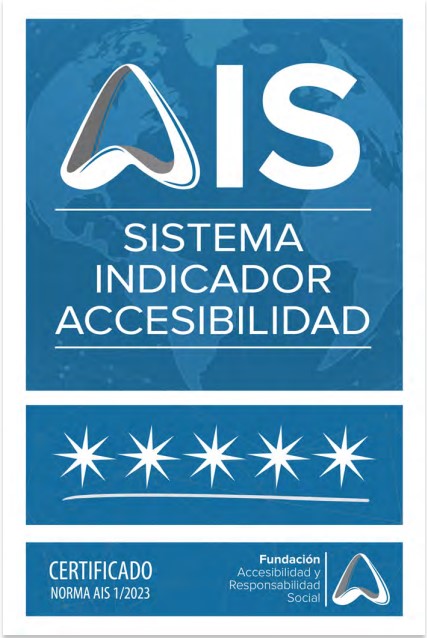
AIS proves that applied mobility, cognitive and sensory solutions consider the prevalence of the needs of interest groups and identifies five levels of accessibility, respecting existing diversity and valuing the efforts made.
These levels measure the degree of accessibility of spaces and buildings and are called AIS Stars.
The system is based on more than 700 requirements and 400 indicators, which verify compliance in grades from 1 to 5 Stars. In addition, it harmonizes standards and requirements from international, national and local regulations of the countries in which the certification is issued.
If you are interested in accessing AIS certification contact us
Leaf Global. Copyright © 2026. All rights reserved.