He leads projects and consulting services under LEED, EDGE, and FITWEL standards, integrating facade optimization strategies, life cycle assessments, and energy modeling to develop high-performance buildings.
Source: Arquit (eco) tura
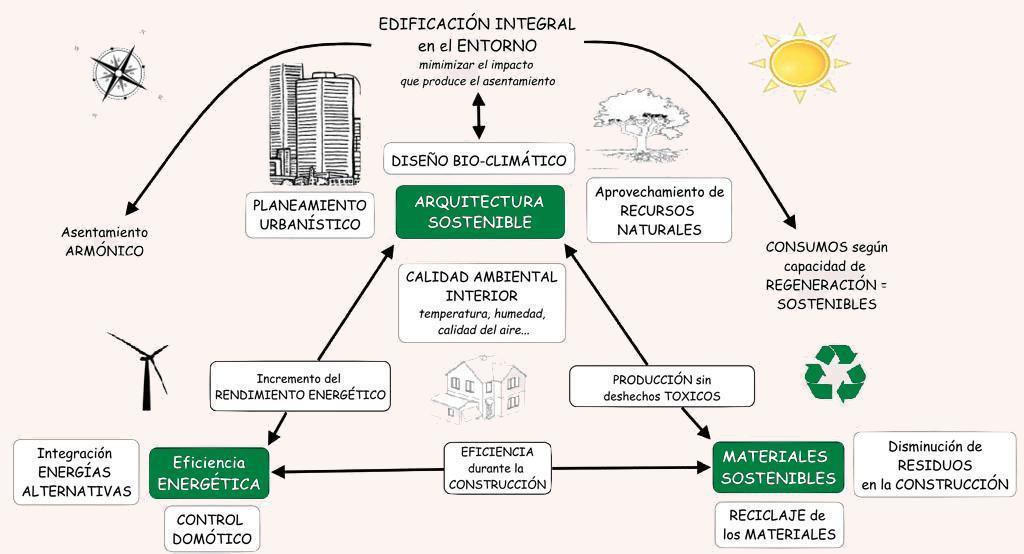
In the search for solutions to address climate collapse, sustainable architecture emerges as a fundamental tool. Reducing emissions and energy efficiency are key aspects to ensure a more sustainable future. In this article, we will explore the connection between sustainable architecture, energy efficiency and the use of sustainable materials, highlighting the importance of a comprehensive approach to addressing environmental challenges.
To implement sustainable measures in existing buildings, it is necessary to carry out an exhaustive study of the current state of the built plant. This analysis should address aspects such as energy consumption, construction characteristics, the performance of air conditioning and lighting systems, and waste and water management. The advice of specialists in sustainability is crucial for evaluating buildings based on specific criteria.
The rehabilitation of existing buildings is presented as a more sustainable alternative than the construction of new buildings. By adopting a functional design, the use of sustainable materials and the installation of efficient equipment, it is possible to significantly reduce energy consumption and associated pollution. In this regard, it is essential to establish a plan at the national level that defines clear sustainability criteria and promotes rehabilitation as a viable option.
Building sustainability is not limited only to the building itself, but it extends to wider areas such as urban planning and economic, social and environmental policies. Adopting a comprehensive approach requires the collaboration of all the actors involved to achieve a true sustainable architecture.
To carry out the points mentioned above, it is necessary to implement a communication and social education campaign to make citizens aware of the importance of these measures. In addition, financial aid plans must be established, through grants and soft loans, to facilitate rehabilitation intervention. Finally, an adequate architectural design must be required that minimizes energy demand, optimizes resources and materials, and improves the comfort and well-being of the occupants.
Energy efficiency and the use of sustainable materials are intrinsically linked in sustainable architecture. The design of an efficient thermal envelope, the incorporation of natural lighting and the appropriate orientation of the building can significantly reduce energy consumption. In addition, the choice of sustainable materials, such as those of local origin and durable, helps to reduce environmental impact and improve the quality of life of occupants.
La sustainable architecture, energy efficiency and the use of sustainable materials are key elements in addressing environmental challenges and building a more sustainable future. The rehabilitation of existing buildings, based on an appropriate architectural design and the adoption of efficient technologies, is presented as a viable solution. It is essential to promote actions at the national level and promote social awareness of the importance of these measures to achieve a true sustainable architecture and mitigate the effects of climate change.
Leaf Global. Copyright © 2026. All rights reserved.