He leads projects and consulting services under LEED, EDGE, and FITWEL standards, integrating facade optimization strategies, life cycle assessments, and energy modeling to develop high-performance buildings.
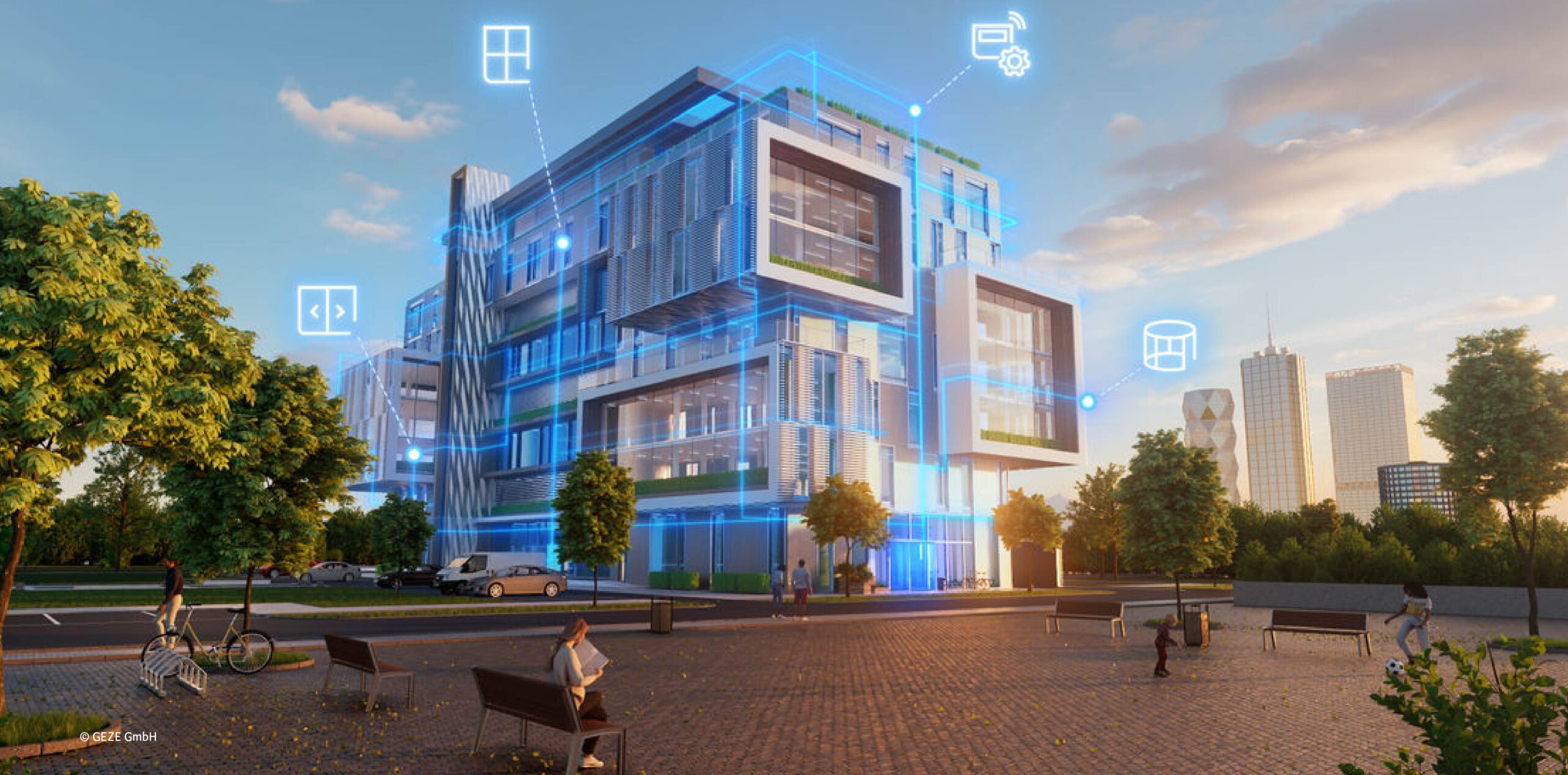
Do you want to make your construction projects more sustainable? The tools of IA available today in the market can help you optimize resources and minimize environmental impact.

© GEZE GmbH
Artificial intelligence (AI) is revolutionizing the way in which the sustainable construction sector is designed and built. This technology allows architects, engineers and designers to make smarter and more informed decisions, optimize the use of resources, reduce human errors and improve the energy efficiency of buildings from the initial stages of the project.
AI tools applied to construction allow:
Imagine a scenario where every design decision is guided by real-time data, environmental assessments and predictive analysis. That is the promise of artificial intelligence in the architecture of the future: to achieve buildings that are not only visually attractive, but that are also aligned with the principles of sustainability and efficiency.
Before a building is built, its environmental impact can be significantly reduced from the conceptual stage. Simulation tools powered by artificial intelligence make it possible to precisely model factors such as sunlight, wind, natural ventilation, energy consumption or thermal comfort, facilitating more informed decisions from the beginning of architectural design.
This data-driven approach offers multiple benefits:
By combining AI with simulation tools, a powerful convergence is achieved: parametric design, sustainability, and energy efficiency in a single continuous and predictive process.

AI tools for construction
Artificial intelligence (AI) tools are transforming the construction industry by driving more efficient, sustainable and accurate projects. From generative design platforms to the use of intelligent drones to monitor works, these technology solutions for architects and designers are redefining how projects are planned, managed and executed in the built environment.
Here is our selection of the 10 best AI tools for sustainable construction which are marking a before and after in the way architects, designers and industry professionals in general design and build. It's important to keep in mind that the AI ecosystem is being updated every week, so it's important to keep up to date with the latest tools and innovations that promote sustainability in the sector:
Cove.Tool is a real-time environmental analysis platform that allows:
Used primarily by architects and designers, Cove.Tool makes it easier to make decisions based on data, resulting in more sustainable and efficient buildings. This tool is essential for those looking to integrate the sustainability solution into the design process from the start.
You can access COVE here --> 🔗 https://cove.inc/
BrainBox AI is an energy optimization technology that:
With BrainBox AI, heating, ventilation and air conditioning systems are automatically adjusted, ensuring a comfortable and efficient system. This tool is ideal for those looking to reduce environmental impact and improve the sustainability of their construction projects through machine learning.
You can access BrainBox here --> 🔗 https://brainboxai.com/
Buildots is mainly used in commercial construction projects and has cameras in helmets that allow a real-time analysis of construction progress, comparing this with plans and 3D models. This tool improves accountability and team management, ensuring that project operations stay on track.
The cost of using Buildots varies depending on the scope of the project and the adapted subscription models, but the benefits in terms of monitoring and managing progress far outweigh the investment. This technology is essential for maintaining transparency and efficiency in construction projects.
You can access Buildots here --> 🔗 https://www.buildots.com
OpenSpace AI uses 360 cameras and AI to capture automatic images of sites, providing accurate and continuous documentation of the progress of the work. The benefits of OpenSpace AI include continuous quality control, improved documentation, and reduced disputes.
Ideal for project managers in complex constructions, OpenSpace AI ensures that each stage of the project is well documented and aligned with the original plans. The cost of this tool varies depending on the size of the project and specific project management needs.
You can access OpenSpace here --> 🔗https://www.openspace.ai
TestFit uses generative design algorithms to accelerate feasibility studies and optimize land uses in accordance with urban planning regulations. This tool allows developers to quickly evaluate different scenarios and select the most suitable one for their design projects.
Promoting more sustainable developments, TestFit integrates urban planning regulations from the beginning of the design process, ensuring that projects are efficient and environmentally friendly. This tool is essential for urban planning and land use optimization.
You can access TestFit here --> 🔗https://www.testfit.io
DroneDeploy is a tool that uses drones with artificial intelligence to:
By creating maps and 3D models, DroneDeploy provides continuous monitoring of project progress, optimizing resource management and ensuring that everything stays on track.
You can access DroneDeploy here --> 🔗https://www.dronedeploy.com
Togal.AI is an innovative tool that allows automatic measurements on PDF/CAD drawings using computer vision. This technology accelerates quantification and estimation processes, eliminating the need for manual calculations and reducing time and costs in construction projects.
With Togal.AI, planning becomes more efficient and waste is minimized, favoring sustainable construction practices. This tool is essential for those looking to improve accuracy and efficiency in their projects.
You can access Togal here --> 🔗 https://www.togal.ai
ALICE Technologies is a tool that optimizes work planning using artificial intelligence, with the following features:
Tools such as ALICE are essential to achieve greener construction aligned with sustainability objectives. ALICE maximizes efficiency capabilities before construction begins, ensuring that each project is executed optimally.
You can access ALICE Technologies here --> 🔗 https://www.alicetechnologies.com
Veras allows for the quick and stylish visualization of BIM/CAD models, improving creative capacity and the exploration of sustainable options. D5 Render, an AI-powered real-time rendering tool, offers features such as virtual paths, ray tracing and automatic lighting adjustment, facilitating high-quality visualizations.
With Veras, users can convert models into high-impact images, ensuring that visual representations are detailed and effective for decision-making. This tool is an essential ally for architects and designers who seek to improve their creative processes, using the 3D model, printing, creations and the shape of the model for their clients.
You can access Veras here --> 🔗 https://www.evolvelab.io/veras
Autodesk Forma is a cloud-based platform that uses artificial intelligence to assist in the initial stages of urban and architectural design. It allows us to evaluate factors such as sunlight, wind, energy, noise and local regulations in real time, facilitating the creation of more informed and efficient sustainable proposals from the beginning of the project.
With Autodesk Forma, design teams can explore multiple scenarios, optimize decisions early and reduce the environmental impact of the project. Its integration with other Autodesk tools, such as Revit, allows for a smooth transition to more advanced design phases.
You can access Autodesk Forma here --> 🔗 https://www.autodesk.com/products/forma/overview

Chinese construction companies use AI to monitor worker safety — via SCMP. Excerpted from parametric-architecture.com

Leewayhertz
Artificial intelligence provides multiple advantages and benefits to construction, making it possible to optimize processes, reduce costs and minimize the environmental impact of projects. Thanks to its ability to analyze large volumes of data (Big Data), AI can identify opportunities to reduce emissions in the supply chain, improve operational efficiency and optimize the use of materials and resources from the initial stages of a project design.
Among its main advantages are:
Implementing AI in building projects makes it possible to accelerate informed decision-making, guarantee quality standards and promote responsible practices in the face of the growth of the sector. In short, artificial intelligence is positioned as a key ally of architects, engineers and designers, to achieve more efficient, intelligent and sustainable buildings.

Using AI on The Novus
Several sustainable construction projects that have incorporated artificial intelligence (AI) are demonstrating significant advances in energy efficiency, resource optimization and reduction of environmental impact.
A prominent example is the new building Columbus Circle, developed by Eyal Ofer at 1841 Broadway, New York. It is the first in the city to use Buildots AI technology, a platform that processes images captured by 360° cameras mounted on construction helmets and automatically compares them with project plans and schedules. This integration made it possible to improve time management, increase transparency and reduce operating costs during the construction of the skyscraper.
Another emblematic case is that of The Edge, in Amsterdam, considered one of the most sustainable buildings in the world. This project incorporates an advanced network of sensors connected to AI systems that monitor in real time the use of lighting, air conditioning, space occupancy and energy consumption. Thanks to this operational intelligence, the building optimizes its energy performance, improves user comfort and minimizes its environmental footprint.
It also stands out The Novus, the tallest residential building in Durham, North Carolina. This project once again implemented the Buildots platform, applying computer vision to record and compare work progress with planned plans. The result was better quality control, anticipation of delays and greater efficiency in the use of resources, demonstrating how AI also transforms the construction phase in terms of sustainability.
Although in Latin America the use of AI in construction is still in an early adoption phase, promising advances are already being seen. For example, the Holcim Technological Innovation Center (CITH) in Ecuador uses AI and robotics for 3D printing of structures and predictive management in plants.
In addition, institutions such as Zigurat and EADIC actively promote the use of generative design and predictive analysis with AI in built environment projects, laying the foundations for a more sustainable transformation in the region.
The implementation of artificial intelligence in construction represents a real opportunity to accelerate the transition to more sustainable, resilient and intelligent buildings. As these technologies continue to evolve, their positive impact on the sector will be increasingly visible, driving a new era of efficiency, innovation and environmental commitment.

AI in sustainable construction
Implementing artificial intelligence (AI) in construction requires considering several key factors:
First, the costs associated with AI tools can vary significantly depending on the scale and complexity of the project, including subscriptions, licenses and technological infrastructure needs. In addition, it is essential that AI systems are transparent and auditable, ensuring that automated decisions are understandable to all project actors.
It is also crucial to address ethical and technical issues. Avoiding data bias and ensuring responsible use of information is essential to promote an equitable and inclusive industry. At the technical level, challenges include integration with existing systems, cross-platform compatibility, and the need for high-quality data to achieve accurate and reliable results.
La artificial intelligence is revolutionizing the sustainable construction industry. From generative design tools to carbon verification platforms, AI offers innovative solutions that optimize energy performance, improve sustainability and reduce the environmental impact of projects. The adoption of these technologies can make a big difference in the fight against climate change and in reducing the environmental impact of the sector.
Among the most widely used are Cove.Tool and BrainBox AI for energy efficiency, Buildots and OpenSpace AI for construction monitoring, and TestFit and Autodesk Forma for generative design from the earliest stages.
Yes. The same energy efficiency and resource management tools that AI uses help meet the standards evaluated by certifications like LEED.
Cost varies depending on the scope of the project and each tool's subscription model, ranging from more accessible platforms to custom enterprise solutions.
The future of sustainable construction is promising with the use of artificial intelligence. By integrating these tools into projects, we can create more efficient, responsible and sustainable buildings.
Leaf Global. Copyright © 2026. All rights reserved.