Buildings with Positive Water Balance

Home

>

Blog

>

Buildings with Positive Water Balance

In today's world, where water scarcity is a growing concern, sustainable architecture is positioned as a key force for change. In this article, we will explore the concept of buildings with a positive water balance and how this innovative approach is integrated with recognized certifications such as LEED and EDGE, marking a milestone in sustainable construction.

What does Positive Water Balance mean or”Net Positive Water Balance”?

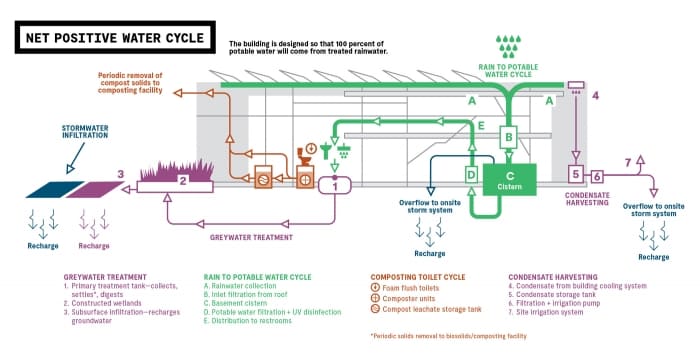
The term “positive water balance” refers to a building's ability to collect and use more water than it consumes. El positive water balance cycle in buildings Start with the rainwater collection, channeling it to strategic storage systems.

This stored water serves as a reserve for later use, after undergoing on-site treatment that guarantees its quality and safety. Priority is given to efficient use of water in the building, with the implementation of appliances and accessories that minimize consumption.

In addition, real-time monitoring systems monitor consumption and detect potential leaks for precise control. After use, the water can be treated again for reuse or return to the environment in a sustainable manner.

Positive water balance cycle in buildings

Design Principles for Buildings with Positive Water Balance

Let's dive into the design principles that architects follow to create buildings with a positive water balance. These principles, when applied comprehensively, not only achieve a positive water balance in the building, but they also set a standard for sustainable construction, contributing to a future where responsible water management is the norm.

  1. Rainwater Collection: It implements efficient systems for capturing and storing rainwater, reducing dependence on external sources.
  2. On-Site Treatment: It uses on-site treatment systems to ensure the quality of the collected water and its safe use in the building.
  3. Water Use Efficiency: It integrates efficient appliances and accessories that minimize water consumption in all areas of the building.
  4. Sustainable Landscape Design: Plan the landscape with a sustainable approach, choosing native plants and efficient irrigation systems to reduce water demand.
  5. Innovative Storage: Design creative storage solutions, such as underground tanks or rooftop tanks, to ensure adequate reserves.
  6. Intelligent Monitoring and Management: It implements real-time monitoring technologies for accurate control of water consumption and the early detection of potential leaks.
  7. Education and Awareness: It promotes awareness programs among building occupants to promote responsible water practices.
  8. Adaptability to Local Conditions: Design considering the local environment, adapting to climatic and geographical conditions for optimal efficiency.
  9. Integration with Sustainable Certifications: Align the design with recognized certifications such as LEED and EDGE to ensure sustainable practices and gain recognition.
  10. Life Cycle Approach: It adopts a life cycle perspective, considering not only operational consumption but also the total water footprint from production to material disposal.

Si quieres recibir este ebook,
¡suscríbete!

Portada de ebook azul con texto sobre oportunidades de financiamiento para construcción sostenible en América Latina y logo de Leaf.

Para Leaf, tu privacidad es fundamental. Por eso, utilizamos los datos que nos proporcionas para acercarte novedades e información relevante. Al descargar, muestras tu conformidad con ello. Puedes cancelar tu suscripción en cualquier momento.

Thank you! Your submission has been received!
Oops! Something went wrong while submitting the form.
EDGE Certification: The Fastest Way to Build an Efficient Building

EDGE certification is one of the fastest and most effective ways to create efficient buildings, reduce energy, water, and material consumption, and increase property resale value. Developed by the International Finance Corporation (IFC), part of the World Bank Group, EDGE helps real estate projects lower their environmental impact, reduce operating costs, and support decarbonization efforts. With a streamlined and measurable process, EDGE has become a strategic certification for developers and investors seeking sustainability, profitability, and market differentiation.

Sustainable certifications in Mexico: current overview and trends

Sustainable certifications in Mexico are gaining prominence as a key tool for companies and projects that seek to demonstrate their environmental, social and governance commitment. They are no longer limited to construction alone, but encompass complete processes, operations, products and business models.

Why environmental certifications increase the resale value of a property | Leaf

Discover how environmental certifications, energy efficiency and sustainable buildings increase the resale value of a property and reduce its environmental impact.

Logo with the word 'leaf' in white and text 'Sostenibilidad para todos' in blue next to two green leaves.

PERÚ

PANAMÁ

COLOMBIA

CHILE

CHINA

MÉXICO

CDMX

Monterey

SÍGUENOS EN

Instagram logo
Logo facebookLogotipo de LinkedIn en blanco sobre fondo azul.