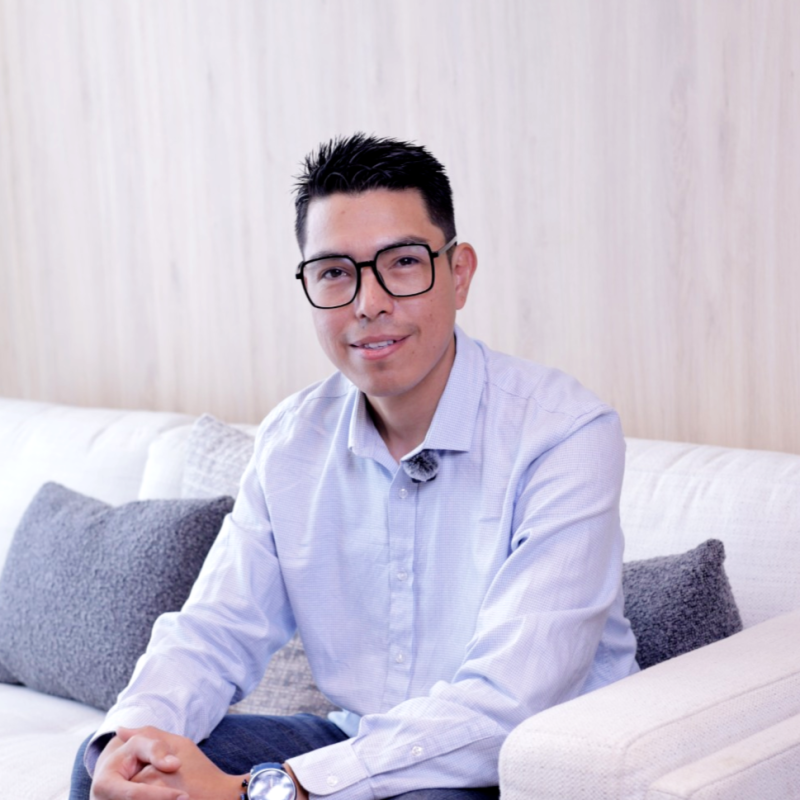
He leads projects and consulting services under LEED, EDGE, and FITWEL standards, integrating facade optimization strategies, life cycle assessments, and energy modeling to develop high-performance buildings.

WELL Health-Safety Rating is a label released by the International WELL Building Institute, after a group of almost 600 professionals public health professionals, virologists, government officials, academics, business leaders, architects, designers, construction scientists and real estate professionals met to help guide a concrete and effective response to the COVID-19 pandemic. It should be noted that our CEO and Co-Founder, Ana Lucía Granda, was one of the 7 Latin Americans who participated in the development of the label.
To help reduce the risk of transmission of different viruses and respiratory diseases, since the strategies implemented are wide-ranging and apply to various health and safety problems.
The WELL Health-Safety Rating aims to support not only offices, But also restaurants, shops, venues, schools, industrial facilities, common and residential areas, places of worship and all kinds of spaces. From large and busy sports centers to small workspaces can begin to reopen in conditions where people feel confident, safe and calm.
The seal focuses on six major health and safety issues and includes more than 20 strategies, of which a minimum of 15 must be met. The 6 topics are:
The implementation of the WELL Health-Safety Rating requires the participation of a specialized WELL consultant to accompany the entire process. For this reason, at Leaf Latam, we focus on customer needs, we seek the best solution for their projects in a cost-effective manner and we accompany them in a personalized way throughout the process to ensure that the project exceeds the client's expectations.
In addition, we have trained personnel with more than 12 years of experience with whom we are able to be present in 5 Latin American countries: Peru, Mexico, Panama, Ecuador and Uruguay. If you want to have more information, contact us at this link or on the bottom button.
Sustainability and Wellness Specialist | CEO of LEAF S.A.C. | Director of GBC Pe | LEED AP BD+C | LEED Faculty | WELL AP | WELL Faculty | EDGE Auditor | EDGE Expert | EDGE Trainer | Task Force on Covid-19 Member
Leaf Global. Copyright © 2026. All rights reserved.