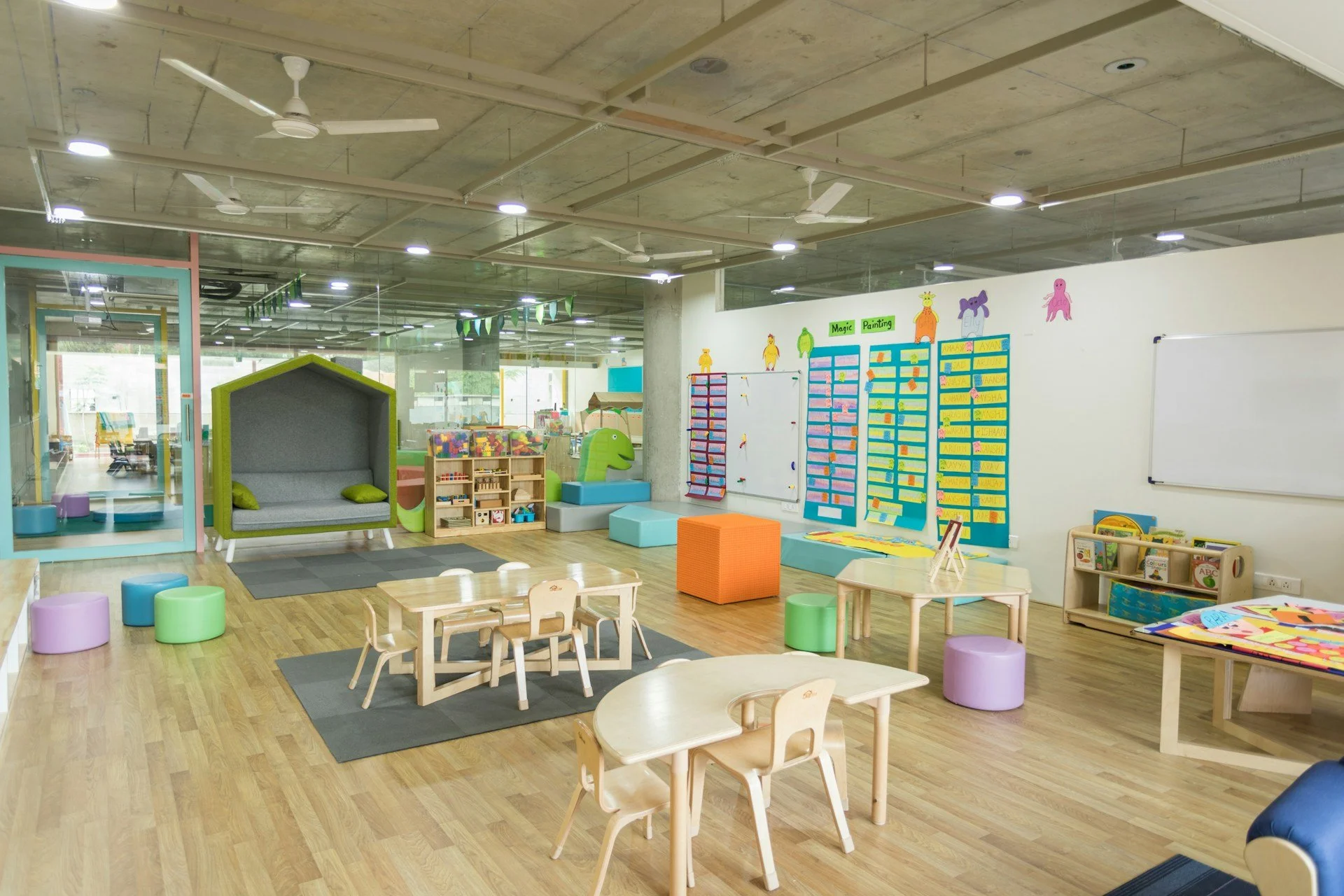
Research from Lawrence Berkeley National Laboratory and Harvard University shows that elevated CO2 levels in classrooms — common in rooms with insufficient ventilation and high student density — measurably reduce concentration and performance on standardized tests. For private schools and universities competing for enrollment in a market where parents and students compare facilities before deciding, that scientific finding translates into a very concrete question: does the classroom air help or hurt learning? WELL for Education is the standard's pathway designed for educational institutions, and it certifies exactly that variable — along with natural light, acoustics, and thermal comfort — with real performance testing, not admissions brochures.
Classroom and common area diagnosis: we measure current CO2 levels, ventilation, natural light, and acoustics against WELL for Education's requirements.
Concept-based strategy: we prioritize Air, Light, and Sound — the concepts with the strongest scientific evidence of impact on academic performance — without neglecting the rest of the standard.
On-site performance verification: we coordinate the physical air and water quality tests an IWBI-accredited performance testing agent carries out in representative classrooms before certification.
GBCI certification and institutional materials: once the seal is obtained, we prepare materials the admissions office can use to communicate the campus's commitment to student wellbeing.
IWBI's fees are calculated by built-area range, plus the cost of on-site performance verification — physical air and water quality tests carried out in representative classrooms and common areas — exclusive to WELL. In educational institutions, the cost premium usually concentrates on mechanical or natural ventilation improvements in classrooms, the line item with the greatest impact on academic performance as measured by scientific evidence. The full process takes 12 to 18 months from registration and requires recertification every three years to keep the seal active.

Studies from Lawrence Berkeley National Laboratory and Harvard University show that elevated CO2 levels, common in classrooms with insufficient ventilation, measurably reduce concentration and performance on standardized cognitive and academic tests.
Yes, with adaptations by institution type. Requirements for classrooms, libraries, laboratories, and common areas adjust to the scale and specific use of each educational level, from basic education to full university campuses.
12 to 18 months on average from registration, including the on-site performance testing period. Campuses with already-renovated ventilation systems can move faster.
Leaf Global. Copyright © 2026. All rights reserved.