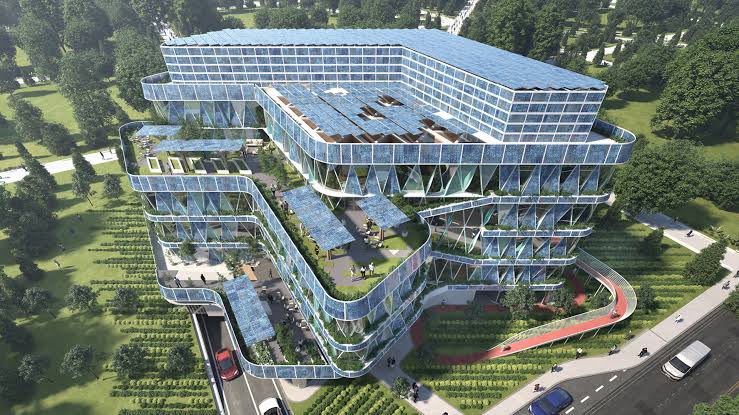
The culture of extended working hours, summed up in the well-known '996', and the 'tang ping' trend among young professionals revealed something companies in China can no longer ignore: burnout has become a retention problem. At the same time, the government is pushing the Healthy China 2030 strategy and the country has its own healthy building standard, putting occupant health on the real estate sector's agenda. For multinationals with offices in Shanghai, Beijing or Shenzhen, the challenge is different: they need a standard that works the same way in their China office as in New York, London or Singapore, so they can report their entire portfolio against one benchmark. Fitwel, created by the U.S. CDC and GSA, answers that with evidence-based strategies —inviting stairs, drinking water, healthy food, break spaces, lactation rooms and active mobility— and a documentation-based certification process that can scale to dozens of sites at once.
Site assessment: we evaluate the office or building against the applicable Fitwel scorecard and benchmark it against the criteria the company already uses at other sites in its portfolio.
Registration and strategy: we register the project with Fitwel and set the target level, from one to three stars, coordinating with local and global Real Estate and ESG teams.
Implementation: we coordinate physical upgrades —stairs, water stations, break areas, bike parking— and adapt global wellbeing, food and emergency policies to operations in China.
Certification: we submit the documentation, secure the seal valid for three years and prepare the site's recertification schedule.
Fitwel charges a registration fee and a certification fee per building or space, with special terms for portfolios, which is key for multinationals with several sites in Asia. Since it doesn't require on-site performance testing, the total cost is well below WELL's. Physical investment is usually limited to break areas, water stations, stair signage and lactation room fit-outs. The process takes 4 to 8 months per site, and certification is valid for three years.

Yes. Both pursue similar goals and many strategies overlap. The Chinese standard carries more weight for local projects and national processes; Fitwel is more useful when a company needs to compare and report its international portfolio under a single standard.
Cost and scale. WELL requires on-site air and water testing in every building, which makes the process more expensive and longer when there are many sites. Fitwel is documentation-based, with no mandatory prerequisites, and lets you move forward with several offices in parallel. Many companies reserve WELL for their regional headquarters and use Fitwel everywhere else.
Yes. Fitwel has a commercial interior space scorecard designed for tenants occupying one or more floors in a building they don't fully control.
Leaf Global. Copyright © 2026. All rights reserved.